

“What we try to do is provide the key updates. Things are moving so fast in our advocacy work, and obviously as a membership organisation we’re trying to get a really good sense of what’s happening for our members at the moment and see what impact we can have by feeding into the Department of Education and Skills…I really try to absorb everything you are saying and it really informs my understanding of everything impacting on learners and practitioners at this time.”
Niamh began by acknowledging the success of the online gathering that has become a weekly staple and proceeded with the weekly update on the work being carried out by the various elements of the COVID-19 Tertiary Education Steering Group. Below is the overview Niamh provided to newcomers of the various groups operating within this overarching structure (Click Here for more context):
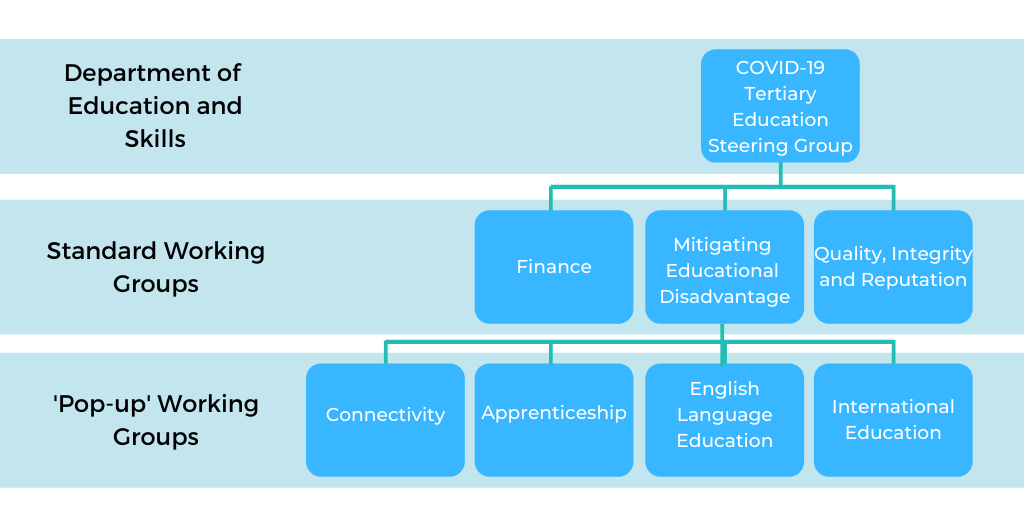
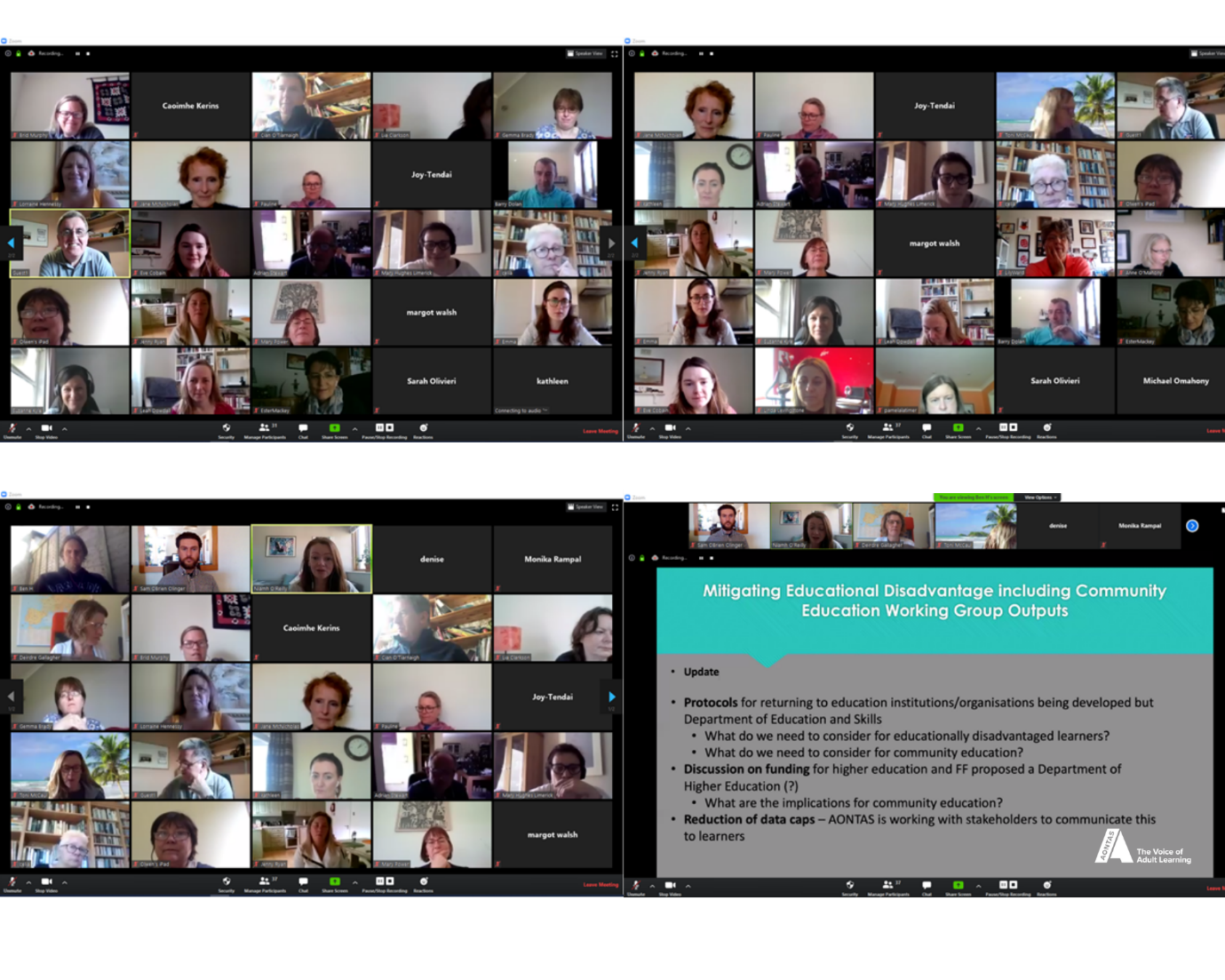
Niamh then covered the most recent outputs of the Mitigating Educational Disadvantage (including Community Education issues) Working Group that she chairs. Some of the most recent outputs include
- Protocols for returning to education institutions/organisations being developed by the Department of Education and Skills
- Discussion on funding for higher education and the proposed Department of Higher Education by Fianna Fail
- Increasing mobile data caps to facilitate learning online
The issues raised in the recent Discussion Paper entitled Educational Equity and Learner Cohorts were also considered (Click Here for more Discussion papers).
Politics, advocacy and the roadmap for reopening
AONTAS Advocacy Lead Ben Hendriksen provided an input on the current political situation as a potential programme for government is being negotiated. Ben also looked at how education systems have been affected worldwide by COVID-19 and where Ireland fits within a global perspective.
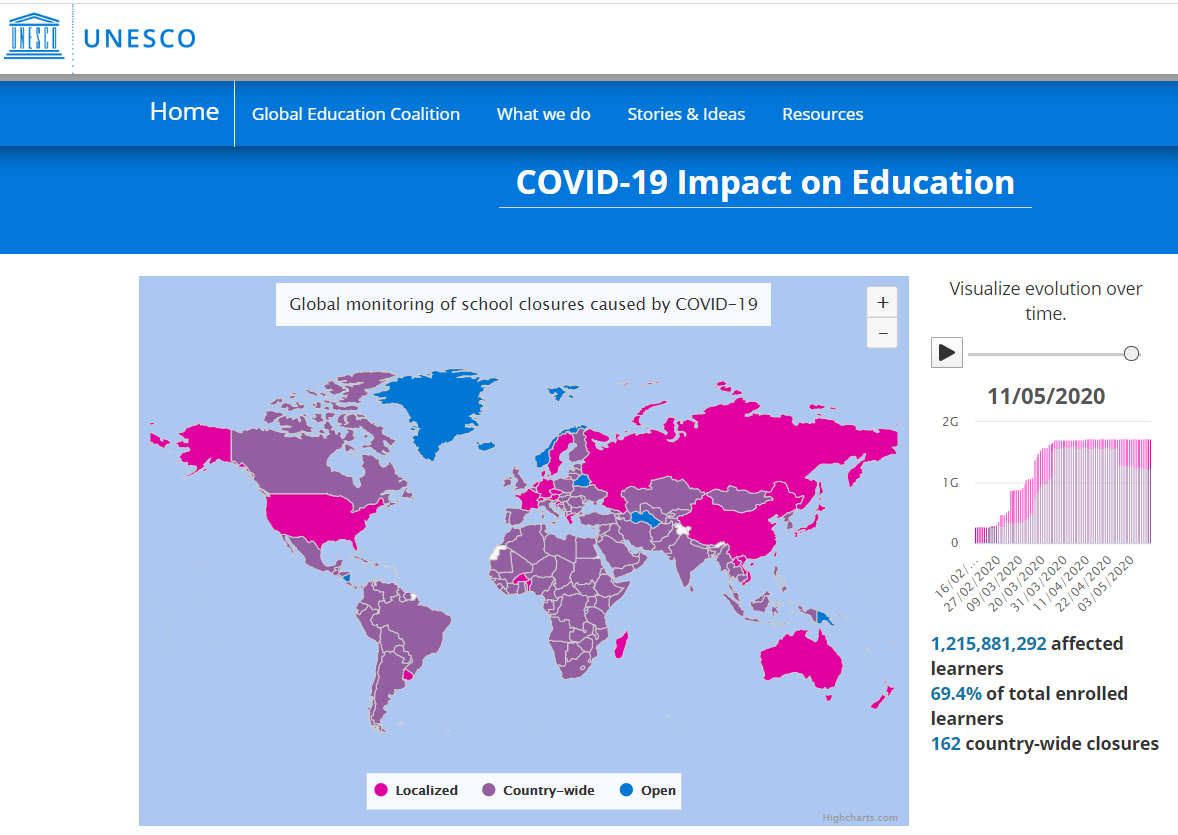
(Click Here to view this visualisation)
Ben then focused on the significance of the new phase system outlined in the government’s recent Roadmap for reopening society and business for AONTAS members, raising questions about the implications for community education and the potential challenges for adult learners. Here participants received an outline of AONTAS activities and communications with political parties on ensuring that community education and further education and training are not overlooked as negotiations to form a government continue.
Breakout discussions
No online meeting today would be complete without participants going into smaller breakout rooms to delve into the topics in more detail. So as happens every week participants then had the opportunity to take some time to talk to their peers from across the adult and community education sector.
“Issues are relevant each week and focused on moving forward. A great deal of change is happening with more to come too, this is a good space to help with the transition.”
– AONTAS member and Webinar participant
Members reflected on the points raised by Niamh and Ben and they shared their issues and the innovative solutions they’ve implemented to overcome what are unprecedented challenges. AONTAS staff were on hand to record these discussions as they unfolded in each of the smaller virtual breakout rooms. Below are some of the highlights from members’ discussions:
__________________________________________________________________________
- How can the sector gather data on learner participation and engagement during COVID-19 that complies with the GDPR?
- In relation to QQI accreditation – how will learners do practical aspect of childcare courses if there is social distancing in place?
- What new CPD and professional supports will be needed for members to mange and cope with returning when it is safe?
- Splitting up learner groups into smaller classes to facilitate social distancing is a concern.
- Concerns around the capacity of small physical spaces to cope with the likely social distancing measures.
- People with intellectual and physical disabilities remain the hardest to reach as their learning can’t transition so easily online.
- There are questions about learners who want to progress from level 5 and 6 courses into Higher Education -where there is a practical element required, what they will need to do?
- What will be the mental health implications be for learners coming ‘out of isolation’ who cannot engage in online learning? What additional resources will be needed to support their return to learning?
- Literacy skills are major barrier to participation in online learning.
- Funding is a concern for many non-statutory providers as the crisis continues.
- Plans are already being put in place to ensure all learners are equipped with digital literacy skills moving forward.
- Concern that buildings/space for some community education providers is not adequate to ensure successful social distancing measures. Will new premises be required to ensure space to social distance?
- If leaners are to come back in autumn how would break rooms, hallways etc be managed.
- Community groups are putting a lot of effort in to keeping in touch with learners
- In some cases, tutors are keeping in touch with each other but there is a fear of tutors becoming burnt out
- Online courses won’t work for a lot of people. This [online learning] can’t now be the new way of working or become the ‘new normal.
- Reengaging after the crisis will have to be done in phases starting with people who have least access from home
- The ability to work with others is a skill required by employers. This crisis could be an opportunity to show how people have managed to do this and be innovative in spite of the crisis.
- We need to think more about the language being used to describe more ‘vulnerable’ groups, for example the term ‘cocooning’ and its association could be a step backwards in terms of positive ageing for older adult learners
- Many tutors and staff feel very isolated –there is an opportunity now to shape the future in terms of supporting staff
- Opportunity now to integrate active citizenship, critical thinking, digital literacy and strengthening democracy in to all programmes in a similar way to how literacy is integrated
___________________________________________________________________________
In closing, Niamh thanked everyone for their participation and asked that people share their points and questions with AONTAS via email and through the survey sent out after every webinar. Members feedback is essential, as Niamh mentioned, in order to “improve and meet your needs and please encourage others to join and be part of this community of support which is definitely beneficial”.
A much-needed space to come together
Without physical meetings all of us have had to learn and adapt to virtual gathering as best we can. As AONTAS has had to move more of its activities, engagement and communication with members online the weekly webinar has become a vital way to support and encourage one another and to enhance the sector’s unity of purpose, while also ensuring our individual and collective wellbeing. Through active participation in these weekly opportunities AONTAS and its members are responding positively and constructively to the depth and breathe of issues at hand. Feedback from surveys sent to attendees consistently indicate that taking life one week at a time, and checking in on one another, has proven to be not only useful for AONTAS, its staff and for members but it has also been invaluable for carrying out work that mitigates educational disadvantage more broadly as evidenced in the Discussion Papers and work done at government level through the Working Groups.
“Please keep doing what you’re doing. Every week I learn something new at this event. And often something that I can drill down further into for the benefit of my own practice and that of my micro organisation.”
– AONTAS member and webinar participant
Hearing from those at the coalface of adult education provision and being able to relay the challenges to government in this way is working. With each new week and the energetic contributions from members this important work will only become more efficient and effective. To ward off ‘webinar burn out’ AONTAS will continue to be creative and responsive to member’s interests, challenges and needs. Finally, and perhaps just as important, the weekly webinar is an enjoyable and unique opportunity to show and experience solidarity despite these trying times.
________________________________________________________________________
To be part of the collective effort to identify and respond to this unprecedented situation Click Here and register for the next AONTAS Membership Update and Engagement Weekly Webinar. These webinars are open to members only and it is essential to register in order to participate.
Further information on AONTAS membership is available here.
Go to AONTAS Blogs for more context and blogs about the current situation as it has been unfolding.