

AONTAS Community Education Network (CEN) Survey 2020
Over the summer months AONTAS has been working with its members to provide resources and practical supports in preparation for returning to work and learning in September. Built-in to AONTAS’ activities around adapting delivery to the current health crisis has been an effort to identify the needs of all members, especially those most under-resourced and those providing for the most marginalised learners, in order to develop an evidence-base for ongoing and future advocacy work. The CEN survey carried out over the last month is just one example; its findings have been invaluable for assessing the current situation and for informing the direction and nature of AONTAS’ activities behalf of members.
‘What does re-opening mean for your organisation post COVID-19 restrictions?’: then and now
On 22nd April, at one of the earliest webinars AONTAS hosted, members were asked ‘what does re-opening mean for your organisation post COVID-19 restrictions?’ (for more on this webinar click here). The issues and concerns raised nearly four months ago were perhaps unsurprisingly also reflected in the very recent CEN survey findings. In April some of the main issues that came up included:
Challenges for AONTAS Members as Organisations
- How will funding be affected in relation to social distancing and safe provision, for example where tutors shifts/hours may need to change to ensure class sizes comply with HSE safety guidelines?
- Will funders adapt by reducing class size requirements?
- Need to ensure that staff and learners are kept safe and feel secure
- What does best practice look like for recruiting in a COVID-19 world?
- What can organisations do to re-establish and reinvigorate the values underpinning adult and community education practice and when?
Challenges Staff may Face
- Everyday working culture and tutors’ practices will have to adapt to ensure safety for all and quality provision to learners
- New innovative ways will be required to re-engage learners and reach new ones
- Older tutors, and staff living with vulnerable family members, with underlying health issues may not be available to work due to cocooning
- What kind and how much Personal Protective Equipment (PPE) will be needed to safely and comfortably continue working?
- What new kinds of Continuous Professional Development (CPD) would support the new way of working?
Challenges for Learners
- How will any stigma associated with COVID-19 be managed?
- For different learner groups, there will be different needs, for example the disproportionate impact of the virus on older learners will need to be considered, those with respiratory vulnerabilities and underlying conditions likewise; lone parents will have another set of concerns that will require flexibility such as anxiety about their children and procuring childcare; those on courses for English for Speakers of Other Languages (ESOL) will need multilingual and accessible signage so communication is clear
- Digital literacy and access to devices are just some of the aspects of what will be needed in terms of the resources required to continue learning online
- Learners’ priorities have shifted away from education to the immediate urgent issues of reduced income and unemployment
- ‘Learning at home’ is not feasible without a home or when living in difficult conditions
The recent findings provide AONTAS with a more robust record that can be used to determine where the organisation and our members now need to focus our collective attention. Similar to members’ main concerns in April the questions around adapting provision remained at the forefront of members’ minds. For example, the second question of the recent survey asked respondents ‘What are your plans for community education provision from this September?’:
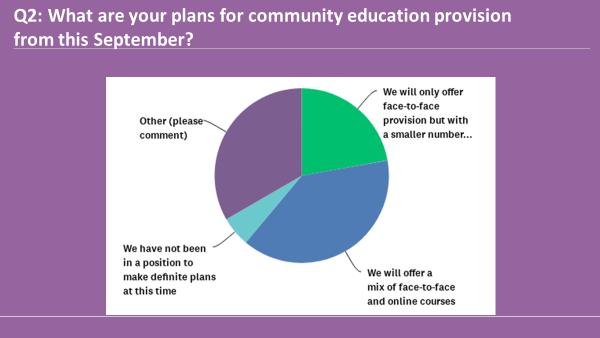
Depending on the organisation’s capacity and resources, the majority fell into two specific categories: offering blended learning or limited face-to-face. Interestingly, no respondents said that they will be halting provision come September which is a testament to the sectors commitment to ensure learners’ needs are met as much as possible given the circumstances.
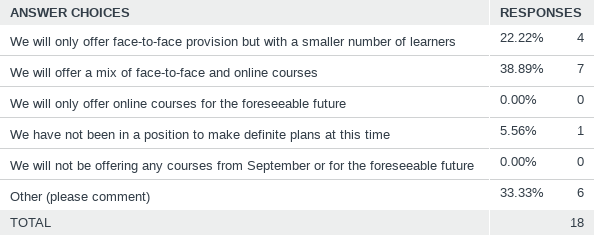
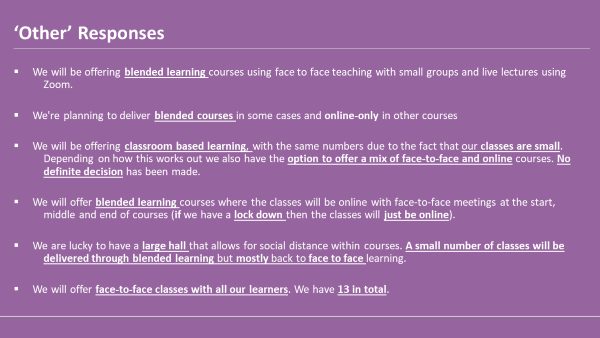
Notably, one-third of those surveyed provided greater insight into their situations by answering ‘Other’ and leaving their comments. Below is a breakdown of their comments.
As was the case in April, current concerns were analysed and found to be grouped into four main areas: health and safety; supporting learners with online access; funding and issues surrounding accreditation. Below is a breakdown of the relevant survey findings.

Like most other sectors and stakeholders within the wider education ecosystem, ensuring that health and safety requirements are met was naturally said to be the leading challenge for community education providers. More specifically, this specific challenge was described by respondents to centre on the following key areas:
- Room space/social distancing
- Contact tracing
- Procedures with suspected cases
- Limited/reduced staff numbers
- Managing responsibilities between limited staff
- Increased admin to meet requirements
“We really need to work face to face with students and concentrate on digital skills to enable them to learn remotely for fear that we would go into lockdown again.” – Survey respondent and AONTAS member
For anyone familiar with the sector the fact that supporting learners came in as a top priority is of no surprise. Previous anxieties about learners and this specific issue have been heard and brought by AONTAS to government as part of its input and role in chairing the Mitigating Educational Disadvantage including Community Education during the COVID-19 Crisis Working Group (MED Group; for more information click here). Digital Learning and Disadvantage across Tertiary Education – A Discussion Paper was produced as part of this work which continues to inform advocacy work on digital literacy and online educational inequality.
AONTAS’ Response
“Workers are exhausted so some support network for tutors and staff would be good too.” – Survey respondent and AONTAS member
With a new government formed, new Department of Further and Higher Education, Research, Innovation and Science established, and a new Further Education and Training Strategy introduced by SOLAS ranking amongst the biggest changes since April, AONTAS now has a sharper picture of the educational landscape. Armed with a more accurate up-to-date evidence-base than ever -through the feedback and discussions gathered at webinars along with the responses from the AONTAS CEN Survey- there is also an increased understanding of how best to support AONTAS members and adult learners moving forward.
Finishing this online presentation on a very positive note, Suzanne Kyle covered the range and nature of supports AONTAS has been and will continue to provide to members. These broadly include training and resources, for example:
Training
- Social media
- Mental health and well-being of practitioners and learners
- Antiracism training
- Delivering blended learning
- Meeting health and safety requirements
- Accessing funding for community education
Resources
- Health and Safety webinar available on the AONTAS YouTube channel
- The COVID-19 Resource Hub
- AONTAS Blogs which cover a wide range of topics
- Latest advocacy publications
For more information about upcoming AONTAS CEN training contact Suzanne Kyle at: skyle@aontas.com.
Another vital support has come in the form of peer-led discussions facilitated by AONTAS during the breakout room section of the weekly virtual gatherings. AONTAS and its members have created an invaluable space for staying connected, sharing concerns and suggesting solutions. More opportunities for networking have evolved and members have become more familiar with each other’s work which has, in turn, strengthened AONTAS’ diverse membership. AONTAS would encourage every member to register and participate in each week’s webinar.
Have your Voice Heard and Inform the Work of AONTAS
The main purpose of the CEN survey was to find out where members of the CEN were at with their preparations for September. The information that came back is informing what areas AONTAS should be focusing more of its attention and advocacy activities. The survey, like the weekly webinars, has not only been a very positive outcome and adaptation to the new circumstances we have all found ourselves in, it has also provided a model for positive and constructive engagement with individual and organisational members across the country when it is needed the most. The level of participation and nature of responses from members to AONTAS’ calls to action and for information via surveys and informal means has been extremely valuable.
Despite all of the uncertainty and anxiety thrown at members throughout the ongoing health crisis, two things have not only remained constant but have grown immeasurably: one, members’ ability to come together as a diverse collective around their shared values and philosophy when faced with challenges that have at times seemed insurmountable; and two, how well members have rallied to support one another in order to continue to achieve our shared local and national aims to improve educational, social and economic equality in Ireland.
To have your voice heard and to help inform the work of AONTAS please contact Dearbháil Lawless, AONTAS Head of Advocacy at: dlawless@aontas.com.
Registration for the upcoming webinars is available on our Events page.
If you would like to become a member of AONTAS or are a member and can contribute to the weekly online gathering with your experience, suggestions and solutions to the common challenges facing the sector then please get in touch with Barry Dolan, AONTAS Communications and Membership Officer at: bdolan@aontas.com or call 087 114 9278.