
We work every day with our members and likeminded organisations to ensure that politicians and policy makers across Ireland and in Brussels understand the importance of lifelong learning for creating a more economically prosperous, but also socially inclusive society. As advocates for the sector, we want to make sure that the issues facing learners and practitioners in adult and community education in Ireland are on every candidate’s radar as they seek election to Local and City Councils and the European Parliament.
Why are Local Elections Important to Adult and Community Education?
Education and Training Boards (ETBs) are regionally based democratic structures created for the governance of the state-run and state-funded Irish education system –a system that extends from childhood through to Further Education and Training (FET) in later stages of life. There are 16 ETBs in Ireland made up of 12 County Councillors and nine representatives of various stakeholder groups.
In the coming local elections, 949 Councillors will be elected to County and City Councils across the country. Once elected, 12 Councillors from the Councils within an ETB area will take seats on the Boards of each ETB. Occupying more than half of all seats on every ETB, locally elected Councillors have a significant impact on the policy development and implementation of adult and community education provision across the country.
The AONTAS Toolkit for Engaging with European and Local Election Candidates
To influence local and EU candidates, AONTAS has created a purpose-built policy tool for those in adult and community education, supporting them in highlighting the importance of their work and lobbying to harness the power of lifelong learning to create a more compassionate, equitable and prosperous society.
Some of the key areas the Toolkit focuses on for engaging with candidates include:
- The removal of barriers to participation in education, such as access to childcare, flexible and part-time learning options, and access to subsidised transportation. Many different barriers to participation that have been recognised and reported at ETB level. These can be found in the 2017 National Further Education and Training Learner Forum Report and the Adult Education Survey 2017 (CSO 2018).
- Funding for non-profit community education providers which covers all aspects of provision beyond the cost of tutors is critical. For example, funding provided by ETBs to community education providers usually does not cover the costs required for general administration, building costs, or special costs like reengagement and programme validation fees that must be paid to another state agency, Quality and Qualifications Ireland (QQI).
You can access the Election Toolkit here.
The European Association for the Education of Adults (EAEA) Manifesto for Adult Learning in the 21st Century: The Power and Joy of Learning
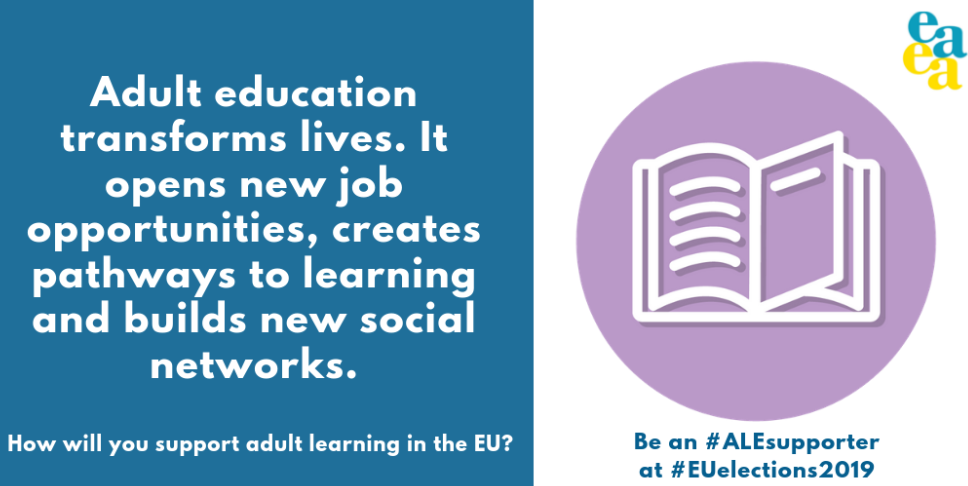
AONTAS has asked MEP (Member of European Parliament) candidates about their position on adult learning based on the EAEA Manifesto 2019. Using the EAEA Manifesto AONTAS has outlined to MEP hopefuls where adult education can play a key role in tackling many of the common challenges facing Ireland and other European societies.
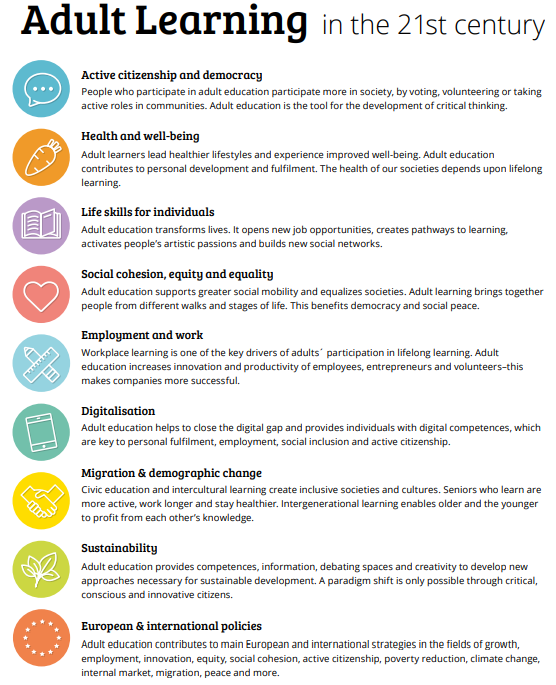
The manifesto communicates the EAEA’s vision of a Learning Europe that is accessible to all, and which centres on gaining necessary skills, knowledge and competences. It proposes a Europe-wide effort to develop a knowledge society that can deal with the challenges of our time. Included are nine challenges facing Europe which adult learning helps to address:
The questions put to candidates:
As of Friday 17th May seven candidates have taken the time to consider the future of adult learning in Ireland and Europe and responded to AONTAS. All candidates who responded spoke about the importance of investing in adult and community education and lifelong learning as a tool for developing a more equal Ireland. The questions put to candidates were as follows:
- What does adult and community education, and lifelong learning mean to you?
- How will you as a Member of European Parliament work to promote adult education and lifelong learning? (eg policies, seeking a position on the Education Committee, etc)
- From your experience and opinion, how can marginalised groups (eg elderly, migrants etc) be included in lifelong learning in order to support their social inclusion?
- What do you see as the role for non-formal (non-accredited) adult education in helping to implement EU educational policy considering the challenges posed by Brexit, and the wider benefits of education beyond employment as identified in AONTAS’ lifelong learning for all policy briefs?
- As an MEP will you, and how will you, support the work of civil society actors like AONTAS and the EAEA as we work to advocate for a quality lifelong learning service across Ireland and Europe?
Candidates who responded to AONTAS
|
Constituency |
Candidate Name and Affiliation |
|
Midlands-Northwest |
Fidelma Healy (Independent) |
|
Midlands-Northwest |
Brendan Smith (Fianna Fáil) |
|
Dublin |
Clare Daly (Independent) |
|
Dublin |
Ciarán Cuffe (Green Party) |
|
South |
Breda Gardner (Independent) |
|
South |
Grace O’Sullivan (Green Party) |
|
South |
Malcolm Byrne (Fianna Fáil) |
Note that AONTAS does not endorse any candidate for election. However, the names and constituencies of the candidates are listed for transparency.
Learn more about the specific candidate responses
Before Election Day on 24th May the EAEA will be posting the responses of candidates that have responded to their member organisations across Europe: check out the full response on the EAEA website here.